



Why B2B e-commerce isn't just "B2C as well"
B2C e-commerce has changed significantly in recent years. Marketplaces – led by Amazon – dominate large segments of the business. For many traditional B2C providers, agencies and service providers, the market has become significantly more competitive. At the same time, we’re seeing more and more of these providers now turning their attention to B2B e-commerce. “Let’s do that, too.” “It’s basically the same thing.” “We can handle that.” This trend is understandable. But it carries risks, especially for companies that underestimate B2B projects.
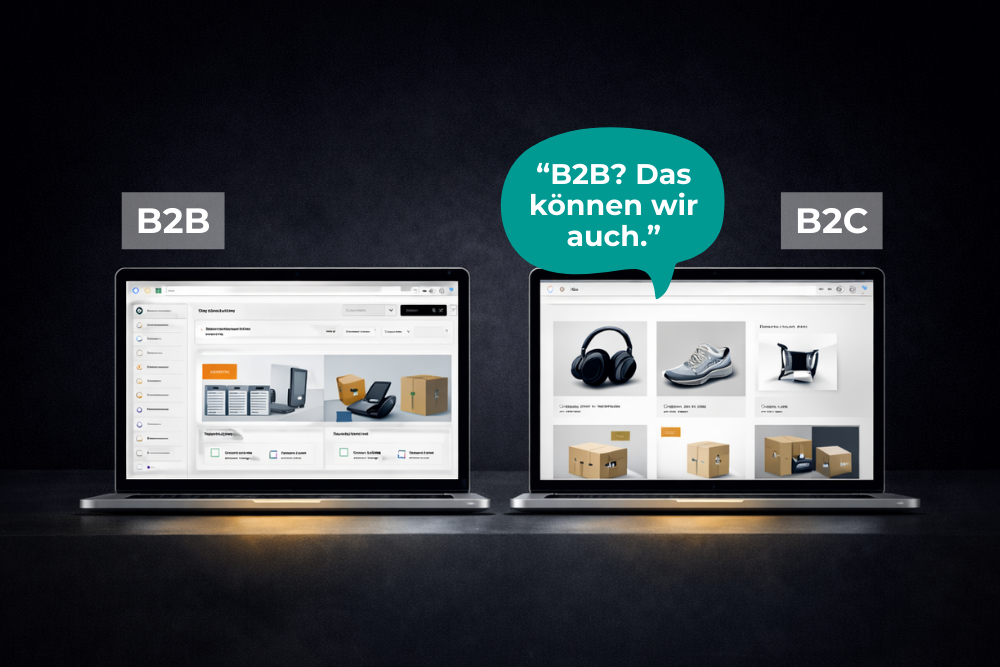
B2B is not just B2C without a VAT invoice
At first glance, B2C and B2B stores look similar. Products, shopping cart, checkout – the user interface is comparable. But when you look deeper, they are two completely different worlds. In B2B, it’s not just about buying, but about processes:
- customer-specific prices and terms
- customized product ranges and access permissions
- complex role and approval structures
- framework agreements, call-offs, projects, cost centers
- invoices, delivery dates, partial deliveries
- and above all: seamless ERP integration
While the front end is often the focus in B2C, process logic is crucial in B2B.
The real difference lies in the systems
B2B e-commerce almost always involves system integration:
- ERP as the leading system for pricing, availability, documents, and processes
- CRM for customers, contacts, and sales logic
- PIM for product data, structures, and media
- and, if necessary, additional systems for logistics, documents, or service
A B2B store is therefore not an isolated project, but part of a system landscape. It can only function sustainably if it is conceived as a platform for processes – not as an upstream sales interface. Anyone who underestimates this complexity quickly ends up creating parallel worlds, duplicate logic and error-prone processes.
Why the current trend is understandable nonetheless
Consolidation in the B2C market is forcing many agencies to reposition themselves. B2B seems attractive: long-term client relationships and more complex projects.
That’s perfectly legitimate. It only becomes problematic when B2B is viewed as a simple extension of a B2C approach – rather than as a distinct discipline with its own requirements for architecture, integration, and standardization.
The risk for businesses
Many B2B companies are facing modernization or replacement projects. They are looking for partners to help them digitize their sales and service processes. If B2B is treated as a “slightly more complicated B2C store” in this context, it often results in:
- significant rework
- increasing complexity
- unstable integrations
- rising operating costs
- frustration in sales and IT
- and systems that are difficult to further develop
Simply because the complexity was underestimated and because too little was invested in stable standards and clean system architectures.
B2B e-commerce is all about organizational and process work
At its core, B2B isn't primarily about design or features, but rather about questions such as:
- Which processes are currently running in the ERP system?
- Which of these must customers be able to use digitally?
- What data is truly clean and available in a structured format?
- How can systems remain consistent, updatable, and maintainable?
- How do we avoid duplicate logic and media breaks?
These aren’t typical e-commerce questions. These are organizational, architectural and platform questions.
Conclusion: Take a strategic approach to B2B
Many B2C agencies and service providers are tentatively venturing into the B2B market but without a clear strategy. They continue to hope for large B2C projects and “take on” B2B work when the opportunity arises. When in doubt, they simply adapt B2C e-commerce software to fit. That’s understandable. But it’s rarely sustainable. It’s much smarter to approach B2B deliberately and strategically: to position yourself clearly, to rely on genuine B2B platforms and to form partnerships with the manufacturers of such systems who consider integration, processes, and scalability from the very beginning.
This results in:
- faster acquisition of genuine B2B expertise
- less technical risk
- clearer architectures
- and more substance in projects, rather than just more man-days
B2B e-commerce isn’t just “B2C plus a few extras.” Those who take it seriously adopt a strategic approach – technologically, architecturally and in terms of partnerships.
Because in the end, it’s not about building a store. It’s about cleanly digitizing business processes on a stable platform.


Setting up B2B e-commerce the right way
B2B is not a “shop project,” but rather process digitization. avanta is a B2B e-commerce platform that can be used to map the specific requirements mentioned above in a standardized way: customer-specific terms and conditions, permissions, approvals, documents and delivery logic – including ERP integration without duplicate logic.